Code Name-
One proposal long debated by fans of the film series is the notion that "James Bond" is merely a code name used by a long line of British secret agents. The idea was used in the non EON film Casino Royale when Connery was not used and Peter Sellers changed his mind about playing James Bond in the film. While it does explain Bond's longevity and frequent changes of appearance, this idea has always been highly controversial.
Neal Purvis and Robert Wade, screenwriters of the Bond series since 1999, had this to say when asked about this theory: "We don't believe Bond is just a transferable codename - and don't like the idea at all. Bond is a character, a special individual, who happens to have been played by different actors.
Die Another Day director Lee Tamahori believed that the name "James Bond" is a code name (like 007) which is given to the best and most accomplished secret agents. The theory is meant to explain the changes in actors (e.g., Roger Moore vs. Timothy Dalton) and Bond's apparent agelessness. The idea was created so that Tamahori could get Connery to make a cameo appearance in the film, and thus explain how it was possible that Connery and Brosnan as Bond could both be on film at the same time.
Tamahori explained the theory: "My idea was basically that there have been several Bonds. It's just a prefix and a code name. Even James Bond is not the guy's name. That's the way I've always been able to view these things from when Connery left and Lazenby and Moore took over, right up to Brosnan. How could this guy be so young still? Of course to me, it is just a prefix and a code name. That means that Connery either died or retired, Moore died or retired and so on. Following that, that allows you to have possibly two James Bonds in a movie. What happened to the others? Were they retired from active service or were they killed? That's where I came from."
The theory, as well as the intent to have Connery cameo in Die Another Day, was rejected by producers Barbara Broccoli and Michael G. Wilson (although a televised news report during production reported erroneously that Connery had filmed a cameo as Bond's father). One and probably the only piece of evidence to support this theory is Lazenby's final line in the pre-title sequence of On Her Majesty's Secret Service where the Bond girl runs away after Bond is ambushed on a beach: "This never happened to the other fellow." The theory is denounced by most fans due to continuity in subsequent films when Bond's wife, Tracy (from On Her Majesty's Secret Service) is mentioned — most notably in The Spy Who Loved Me, where Moore's Bond reacts emotionally when the death of his wife is mentioned. In the later For Your Eyes Only Bond is seen attending Tracy's grave, and Felix Leiter refers to Bond's marriage in Licence to Kill. Also in The World Is Not Enough, when Electra inquires Bond whether he ever lost a loved one, Bond does not give an answer and changes the subject immediately. In addition to this, once in a while, Bond is seen with gadgets and weapons, such as Honey Rider's knife, from previous films that he obviously kept as souvenirs. In the game Everything or Nothing, Brosnan and Moore's Bond at least are intended to be the same individual, as the Brosnan's Bond recalls encountering Jaws and Max Zorin.
A scene was apparently originally planned in On Her Majesty's Secret Service that would feature Bond having plastic surgery as a means of explaining his new appearance, but the scene never made it into production. The idea that the James Bond name — in addition to the 007 number — has been given to subsequent agents was also featured in the Casino Royale satire, where the original James Bond is a retired, legendary British spy who won a VC at the Siege of Mafeking and who berates M for having given his number and name to a brash young agent whose description appears to match Sean Connery's Bond. Later in the film, six further MI6 agents are assigned the name "James Bond 007", including Vesper Lynd and baccarat master Evelyn Tremble.
The theory is supported by the status of some actors in their final appearance. In Timothy Dalton's last film (Licence to Kill) he resigns in order to pursue a personal agenda, and in Pierce Brosnan's final film (Die Another Day) he is abandoned by SIS only to be secretly approached by M offering reinstatement. One could also argue that these films refute the theory because in those films, Bond lost 007 status but was still James Bond.
Daniel Craig's portrayal of James Bond is significant, in that it represented a 'reboot' for the series as it shows the character earning his '00' status. In true to form ambiguous fashion, the Daniel Craig films point to both sides of the argument. For: The character is called "James Bond" prior to being awarded '00' status. Against: The Judi Dench 'M' character is retained. This may well remain a series of "intentional continuity errors".
Cultural Impact-
James Bond has long been a household name and remains a huge influence within the genre. The Austin Powers series by writer, producer and comedian Mike Myers, and other parodies such as Johnny English (2003), Bons baisers de Hong Kong, OK Connery, the "Flint" series starring James Coburn as Derek Flint, the "Matt Helm" movies starring Dean Martin, and Casino Royale (1967) are testaments to Bond's prominence in popular culture.
The Bond series also received many homages and parodies in popular media. The 1960s TV imitations of James Bond such as I Spy, Get Smart, Charles Vine, Matt Helm and The Man from U.N.C.L.E. went on to become popular successes in their own right, the last having enjoyed contributions by Fleming towards its creation: the show's lead character, "Napoleon Solo", was named after a character in Fleming's novel Goldfinger; Fleming also suggested the character name April Dancer, which was later used in the spin-off series The Girl from U.N.C.L.E. A reunion television movie, The Return of the Man from U.N.C.L.E. (1983), is notable for featuring a cameo by George Lazenby as James Bond in tribute to Fleming (for legal reasons, the character was credited as "JB").
George Lucas has said on various occasions that Sean Connery's portrayal of Bond was one of the primary inspirations for the Indiana Jones character, a reason Connery was chosen for the role of Indiana's father in the third film of that series.
Films Overview-
In the late 1950s, EON Productions guaranteed the film adaptation rights for every 007 novel except for Casino Royale (those rights were recovered in 1999). In 1962, the first adaptation Dr. No was made, which featured Sean Connery as 007. Connery starred in six more films after his initial portrayal (including 1983's Never Say Never Again, which was not part of the EON series). George Lazenby replaced Connery (for one film) before the latter's last EON film, after which the part was played by Roger Moore (for seven films), Timothy Dalton(for two films), Pierce Brosnan (for four films) and Daniel Craig (two films to 2008). As of 2008, there have been 22 films in the EON series. The 21st film, Casino Royale, with Daniel Craig as James Bond, premiered on 14 November 2006, with the film going on general release in Asia and the Middle East the following day. Notably, it is the first Bond film to have been released in China. The second James Bond film to feature Daniel Craig is Quantum of Solace, which gets its title from a short story of the same name by Ian Fleming (For Your Eyes Only, 1960), but shares no similarities with the plot.
In April 2010, EON Productions suspended development of Bond 23 indefinitely due to MGM's crippling debt and uncertain future.Prior to this suspension, Craig was expected to return to the franchise for a third time.
The film series has grossed over $4 billion (£2 billion) (nearly $11 billion when adjusted for inflation) worldwide, making it the highest grossing film series ever. The 22nd and newest movie in the series, Quantum of Solace, was released in the UK on 31 October 2008. As of 9 November 2008, global box office totals for Quantum of Solace were almost $161 million (£103 million), placing the Bond series ahead of the Harry Potter film series even when not adjusting for inflation
.gif?timestamp=1565841538835)
Cinematic Bond –
Barry Nelson was the first actor to play James Bond on-screen in a one-hour Americanized version of Casino Royale made in 1954. Patrick McGoohan was the first actor to be offered the role of Bond in the EON series, but he turned it down. The first to portray 007 was Sean Connery inDr. No, released in 1962. Connery played the role in four further films before resigning. Australian actor George Lazenby was cast in On Her Majesty's Secret Service in 1969. However, Lazenby resigned, and Connery returned for the next film, Diamonds Are Forever, in 1971, and later in the non-EON produced Never Say Never Again in 1983, giving him the longest association with the role appearing in seven films over a 21-year period. 1973's Live and Let Die featured Roger Moore's debut as Bond. Moore also appeared in seven consecutive EON produced films between 1973 and 1985.
After Roger Moore's retirement, the role went to Timothy Dalton, who was contracted in 1986 for three films (with an option for a fourth) as James Bond. Dalton starred in The Living Daylights (1987) and Licence to Kill(1989), with the third film planned for 1991. However, legal disputes over ownership of the franchise delayed release until 1995, by which time Dalton had resigned. Persistent rumours state that Dalton's third film was going to be The Property of a Lady, but the story, treatment, and draft screenplays were called GoldenEye.
In 1994, Irish actor Pierce Brosnan was hired as James Bond, having previously been considered as Roger Moore's replacement. Brosnan's debut, GoldenEye (1995), was the franchise's highest-grossing film at that date, and he starred in three more films. Brosnan is the only actor who did not star in a James Bond film titled after an Ian Fleming story and is the second actor not to have been from the United Kingdom, also the only actor who did not resign from the role.
The current actor to play the role is Daniel Craig, hired in 2005. Craig's debut in Casino Royale was successful both critically and commercially. Craig's performance was also the first in the series to earn a BAFTA nomination for Best Actor. The 22nd Bond film, Quantum of Solace, was released in 2008 and the 23rd is scheduled for 2011.
Before Sean Connery was cast as James Bond, Harry Saltzman favoured Roger Moore for the role, while Cubby Broccoli preferred Cary Grant (but the producer ultimately decided against Grant because he knew that if he succeeded in signing him, it would be a one-year deal and the next film would necessitate a search for another Bond). Before George Lazenby was cast in On Her Majesty's Secret Service, Timothy Dalton was offered the part, but turned it down as he then felt himself to be too young for it. Pierce Brosnan was initially approached after Roger Moore relinquished the role, but his contract with the TV show Remington Steele made him unavailable.
In the course of the official series, American actors have been engaged to play James Bond on two occasions — and have been approached at other times as well. John Gavin was contracted in 1970 to replace George Lazenby, but Connery was well-paid to re-appear in Diamonds Are Forever. James Brolin was contracted in 1983, to replace Roger Moore, and prepared to shoot Octopussy when the producers paid Moore to return. To date, the only American to play James Bond is Barry Nelson, in the 1954 American television adaptation of Casino Royale, though Brolin's three screen tests were publicly released for the first time as a special feature named James Brolin: The Man Who Would Be Bond in the Octopussy: Ultimate Edition DVD.
The actors who have portrayed Bond have varied greatly in age. George Lazenby was 29 when On Her Majesty's Secret Service premiered, while Roger Moore was 57 when A View to a Kill was released.
Music-
The "James Bond Theme" was written by Monty Norman and was first orchestrated by the John Barry Orchestra for 1962's Dr. No, although the actual authorship of the music has been a matter of controversy for many years. In 2001, Norman won £30,000 in libel damages from the British paper The Sunday Times, which suggested that Barry was entirely responsible for the composition.
Barry did go on to compose the scores for eleven Bond films in addition to his uncredited contribution to Dr. No, and is credited with the creation of "007", used as an alternate Bond theme in several films, as well as the popular orchestrated theme "On Her Majesty's Secret Service." Both the "James Bond Theme" and "On Her Majesty's Secret Service" have been remixed a number of times by popular artists, including Art of Noise, Moby, Paul Oakenfold, and the Propellerheads. The Beatles used a portion of the "Bond theme" in the introduction of their song "Help" as released on the American version of the "Help" LP. The British/Australian string quartet also named bond (purposely in lower case) recorded their own version of the theme, entitled "Bond on Bond.
Barry's legacy was followed by David Arnold, in addition to other well-known composers such as Chris Minear and Corbin Ott and record producers such as George Martin, Bill Conti, Michael Kamen, Marvin Hamlisch and Éric Serra. Arnold is the series' current composer of choice and composed the score for the 22nd Bond film, Quantum of Solace.
A Bond film staple are the theme songs heard during their title sequences sung by well-known popular singers (which have included Tina Turner, Paul McCartney and Wings, Sheryl Crow and Tom Jones, among many others). Shirley Bassey performed three themes in total. After Doctor No, On Her Majesty's Secret Service is the only Bond film with a solely instrumental theme, though Louis Armstrong's ballad "We Have All the Time in the World", which serves as Bond and his wife Tracy's love song and whose title is Bond's last line in the film, is considered the unofficial theme. Likewise, although the credit sequence to From Russia with Love features an instrumental version of the film's theme, another version, with lyrics sung by Matt Monro, can be partially heard within the film itself, and is featured on the film's soundtrack album.
The themes usually share their names with their film. A large reason for the turning down of Mr. Kiss Kiss Bang Bang for Thunderball was that it was not named after the movie. "Nobody Does It Better", the theme for The Spy Who Loved Me, was the first Bond theme not to share its title with that of the movie, although the words "the spy who loved me" do appear in the lyrics. The song is featured in both credit sequences of the film, and in orchestral form throughout. "Nobody Does It Better" was nominated for an Academy Award for "Best Original Song" of 1977, but lost to the theme song to You Light Up My Life. Hamlisch's score for the film was also nominated for an "Oscar", but lost to John Williams' score for Star Wars.
The only other Bond themes to be nominated for an Academy Award for best song are "Live and Let Die", written by Paul and Linda McCartney and performed by their group Wings, and "For Your Eyes Only", written by Bill Conti and Michael Leeson and performed by Sheena Easton, though a few of John Barry's scores have been nominated.
The only Bond theme to reach number one on the pop charts in the U.S. was Duran Duran's "A View to a Kill."
The only singer, to date, to appear within a title sequence is Sheena Easton during For Your Eyes Only. The only singer of a title song to appear as a character within the film itself, to date, is Madonna, who appeared (uncredited) as fencing instructor Verity, as well as contributing the theme for Die Another Day. The title sequence in Die Another Day is notable, however, for being the only one in which the visuals actually serve to further the plot of the film itself, as opposed to being merely a montage or collage of abstract images related to the film or to the larger James Bond mythos.
The latest theme song is Alicia Keys and Jack White's "Another Way to Die", from Quantum of Solace, the first James Bond theme song to be a duet. It is also the fourth Bond movie that doesn't have the name of the movie in its lyrics.
In 1998, Barry's music from You Only Live Twice was adapted into the hit song Millennium by producer and composer Guy Chambers for British recording artist Robbie Williams. The music video features Williams parodying James Bond, and references other Bond films such as Thunderball and From Russia with Love. It should also be noted that the video was filmed at Pinewood Studios, where most of the Bond films have been made.
In 2004 the Cavaliers Drum and Bugle Corps won the Drum Corps International World Championship with "007," using the music of James Bond as composed by David Arnold. The Cavaliers performed selections from GoldenEye, Die Another Day ("Hovercraft Theme" and "Welcome to Cuba"), and Tomorrow Never Dies.
Burt Bacharach's score for 1967's Casino Royale included "The Look Of Love", nominated for an Academy Award for Best Song, has become a standard for its era, with the biggest-selling version recorded by Sergio Mendes and Brasil '66 (#4 on the Billboard pop charts in 1968). It was heard again in the first Austin Powers film, which was to a degree inspired by Casino Royale.

Vehicles And Gadgets-
Exotic espionage equipment and vehicles are very popular elements of James Bond's literary and cinematic missions. These items often prove critically important to Bond in successfully completing his missions. Fleming's novels and early screen adaptations presented minimal equipment such as the booby-trapped attaché case in From Russia with Love. In Dr. No, Bond's sole gadgets were a Geiger counter and a wristwatch with a luminous (and radioactive) face. The gadgets, however, assumed a higher profile in the 1964 film Goldfinger. The film's success encouraged further espionage equipment from Q Branch to be supplied to Bond. In the opinion of critics, some Bond films have included too many gadgets and vehicles, such as 1979's science fiction-oriented Moonraker and 2002's Die Another Day.
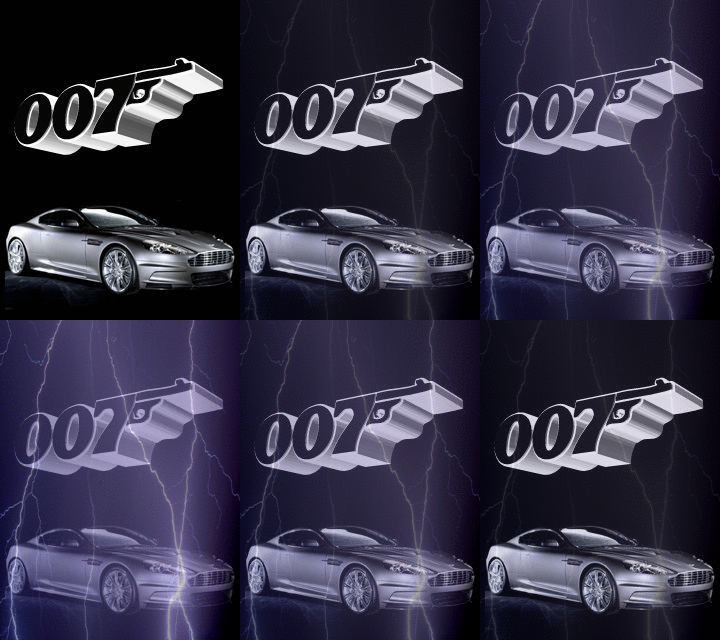
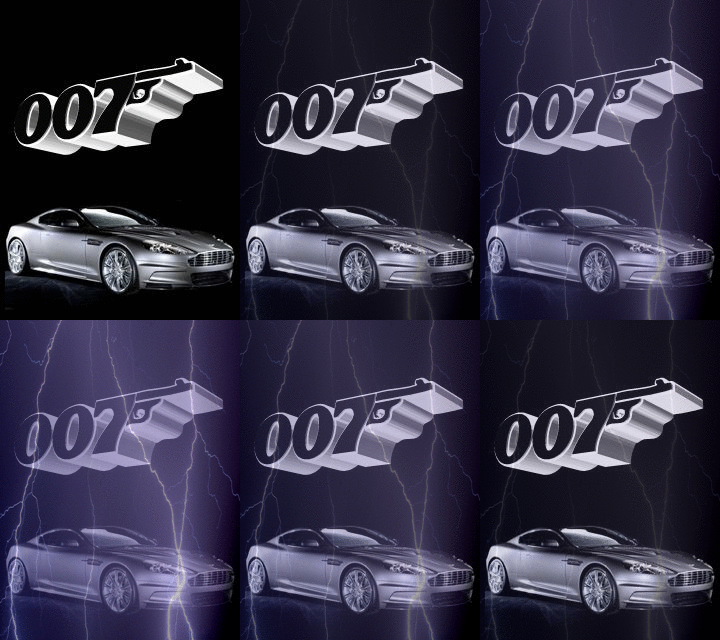
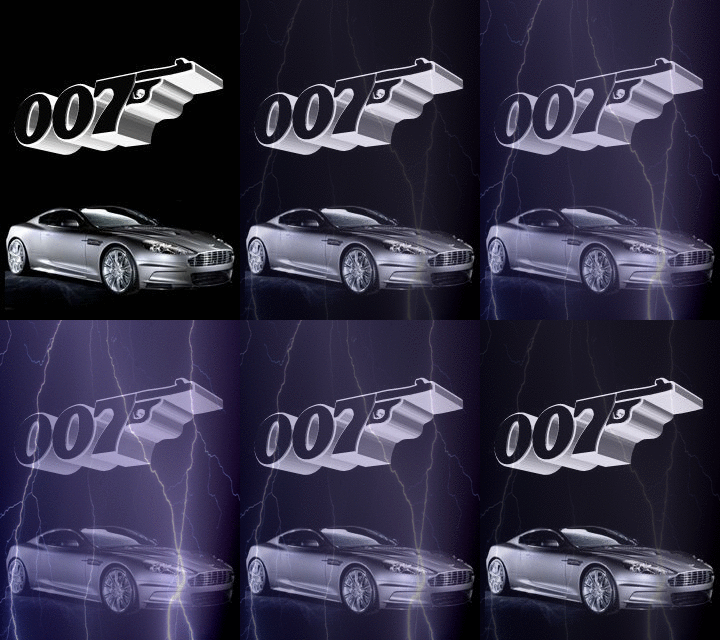
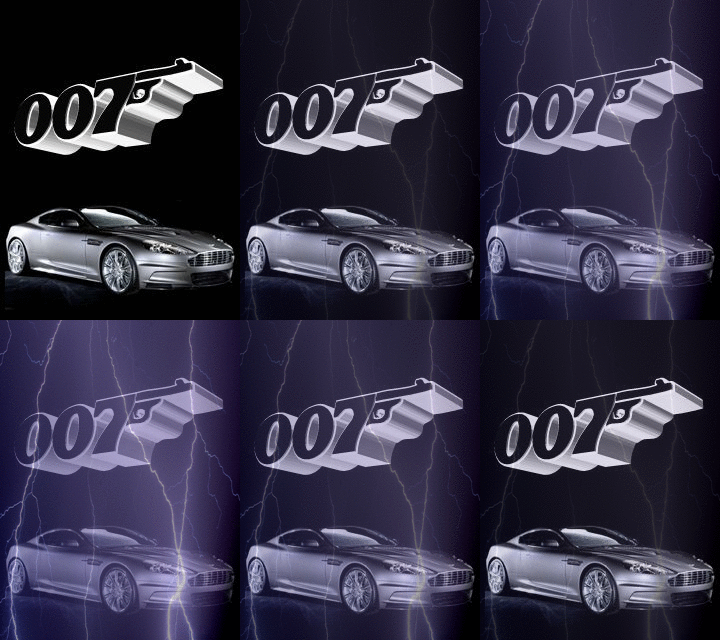
James Bond's cars have included the Aston Martin DB5, V8 Vantage (80s), V12 Vanquish and DBS (00s); the Lotus Esprit; the BMW Z3, BMW 750iL and the BMW Z8. Bond's most famous car is the silver grey Aston Martin DB5, first seen in Goldfinger; it later features inThunderball, GoldenEye, Tomorrow Never Dies, and Casino Royale. The films have used a number of different Aston Martin DB5s for filming and publicity, one of which was sold in January 2006 at an auction in Arizona for $2,090,000 to an unnamed European collector. That specific car was originally sold for £5,000 in 1970.
In Fleming's books, Bond had a penchant for "battleship grey" Bentleys, while Gardner awarded the agent a modified Saab 900 Turbo (nicknamed the Silver Beast) and later a Bentley Mulsanne Turbo.
In the James Bond film adaptations, Bond has been associated with several well-known watches, usually outfitted with high-tech features not found on production models. The Rolex Submariner, one of the few recurring models, was worn by Sean Connery, George Lazenby, Roger Moore, and Timothy Dalton's versions of James Bond. Roger Moore also sported a number of digital watches by Pulsar and Seiko. Pierce Brosnan's and Daniel Craig's James Bonds were both devotees of the Omega Seamaster. The selection of James Bond's watch has been a matter of both style and finance, as product placement agreements with the watch manufacturers have frequently been arranged.
Bond's weapon of choice in the beginning of Dr. No is an Italian-made Beretta 418 .25 calibre, later replaced by the German-madeWalther PPK, chambered in 7.65 mm (a peculiar choice, as Valentin Zukovsky remarks in GoldenEye: the PPK as found in the U.S. and Western Europe is most commonly chambered in .380ACP). The PPK was used in every subsequent film and became his signature weapon until the ending of Tomorrow Never Dies, when Bond upgraded to the Walther P99. He has subsequently used the P99 pistol inTomorrow Never Dies, The World Is Not Enough, Die Another Day, and Casino Royale. Strangely, Bond resumed use of the PPK inQuantum of Solace, the direct sequel of Casino Royale.